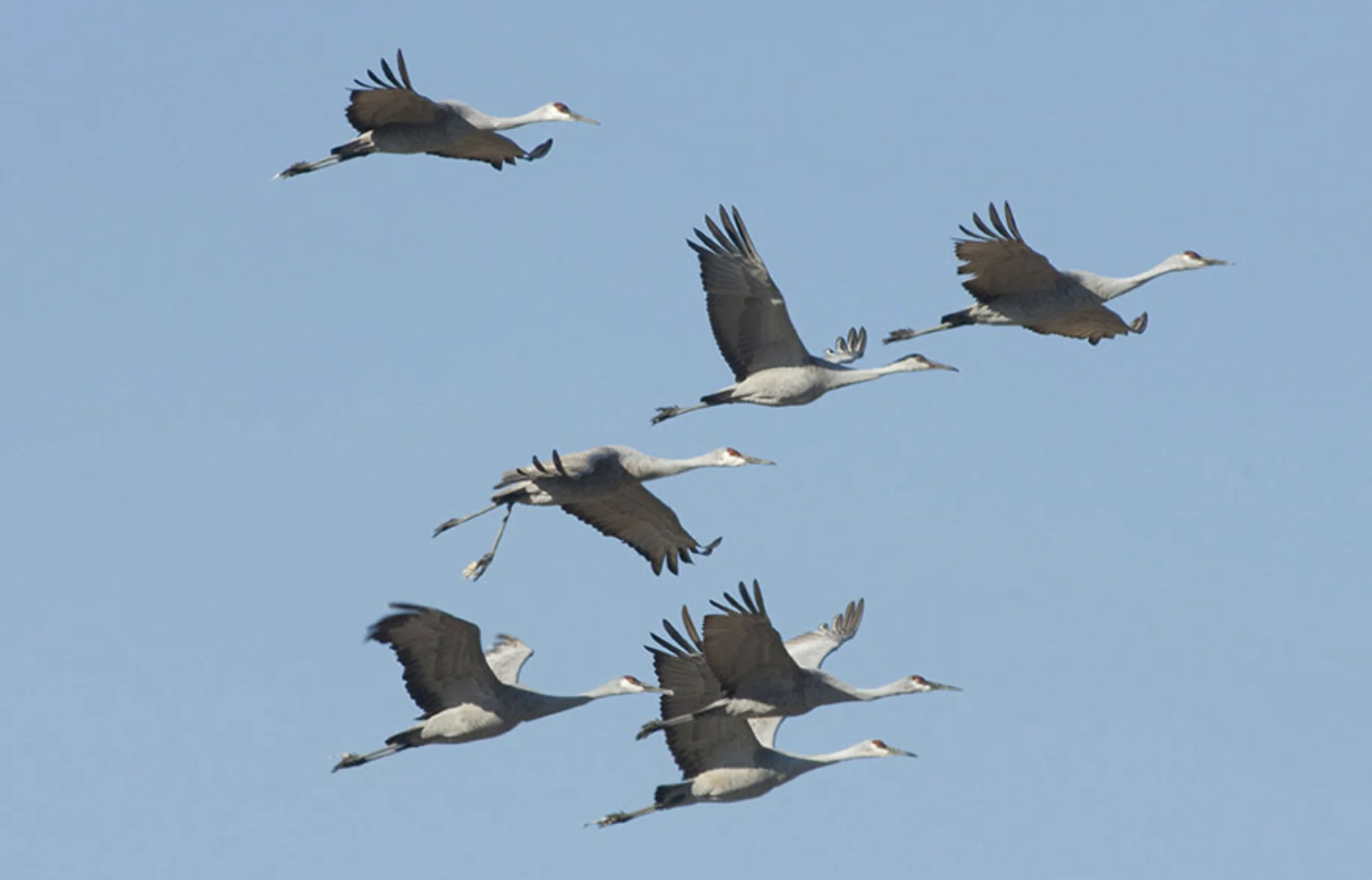
From northern marshes to the open waters of Lake Erie, two striking birds are drawing attention across Ohio this spring: the American white pelican and the sandhill crane.
Wildlife experts say they reflect broader conservation trends, one marking a historic first, the other a steady recovery. Together, they signal a shifting ecological landscape shaped by both progress and change.
For residents and birdwatchers, the message is simple: watch the skies and shorelines. Spring migration is underway, and Ohio’s birdlife is more dynamic than it has been in generations.
Pelicans Mark Historic First in Ohio
For birders scanning the western basin of Lake Erie, spring migration now brings an increasingly familiar sight: white pelicans gliding overhead or resting on open water.
Weighing more than 16 pounds and boasting wingspans up to nine feet, pelicans primarily feed on “rough” fish such as minnows, shiners, and young carp.
Once considered rare in Ohio, pelicans are now increasingly reported across the state, especially in large bodies of water.
The Ohio Department of Natural Resources (ODNR) has reported pelican sightings at several locations.
The best chances to see them come in late March through April and again in the fall.
Though local sightings this year have been reported as early as January this year, when Delaware resident Gwen Grub said she spotted a white pelican at Alum Creek.
“I drove an hour and a half to Alum Creek to see if the American White Pelican was still hanging around. It was so beautiful there with the snow and ice I convinced myself it was okay if I didn't see him, it was still worth the trip,” Grubb said on Facebook. “I walked the length of the beach and as I turned around and headed back to the car there he was! He was joined the ring bill gulls on the beach and proceeded to preen. He is magnificent!”
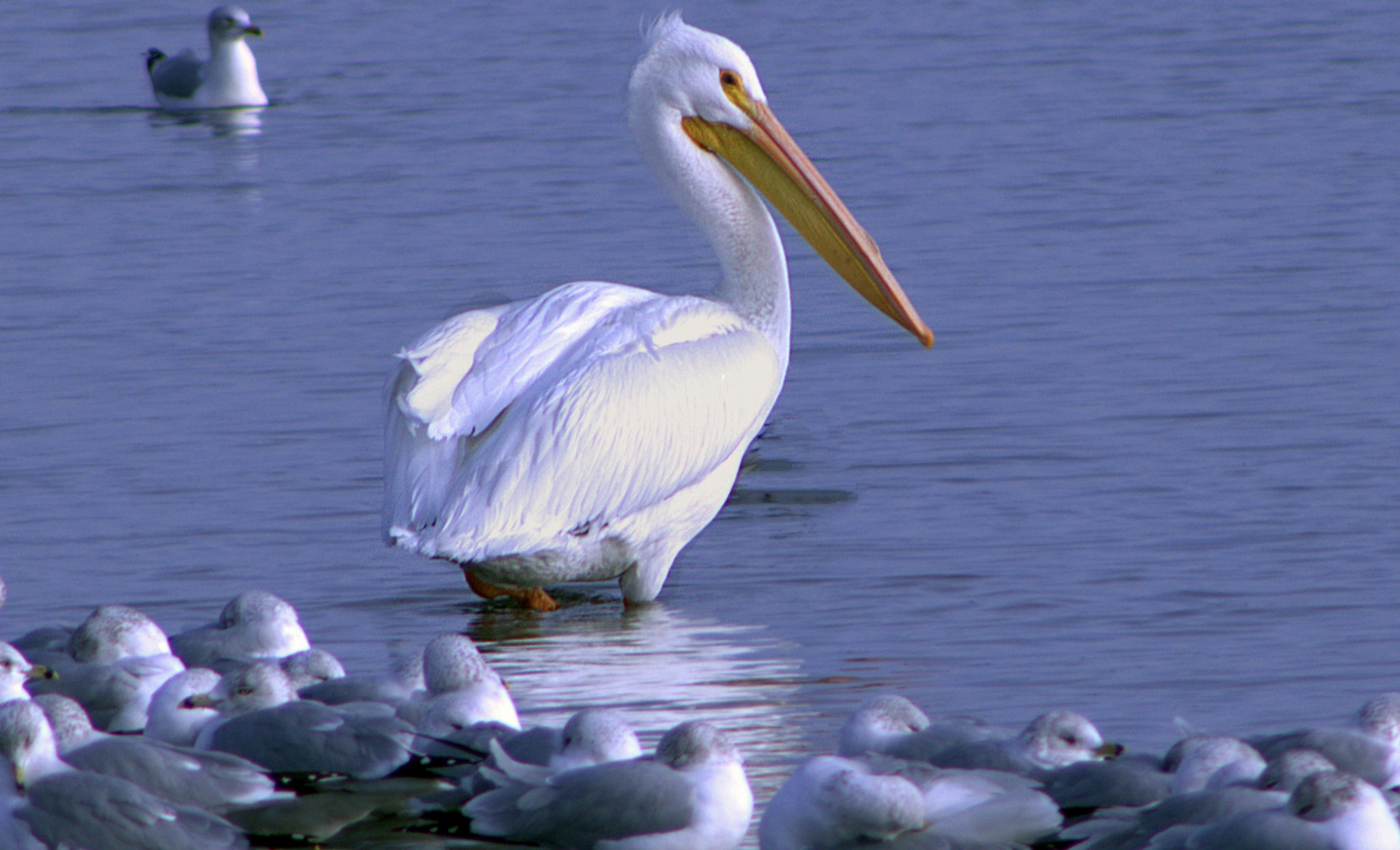
A white pelican spotted by Delaware resident Gwen Grubb at Alum Creek in January. (Facebook / Gwen Grubb)
A 2024 study in The Ohio Journal of Science documented the first confirmed nesting of American white pelicans (Pelecanus erythrorhynchos) in Ohio, on Turning Point Island in Sandusky Bay.
Researchers Bruce Buckingham and Laura Kearns observed the nesting in May 2023 on Turning Point Island in Sandusky Bay, where they identified multiple nests during routine bird surveys.
Researchers initially counted at least four nests containing eggs or young, followed by observations of six adults and a minimum of 12 nearly fledged juveniles.
The study emphasizes the broader scientific importance of the discovery.
“The discovery and documentation of a new breeding species in the state is a crucial first step in understanding the natural history of a species and its consequent needs for management and conservation,” Buckingham and Kearns wrote in the Ohio Journal of Science.
Experts believe the expansion of white pelicans into Ohio is not entirely surprising, given established breeding populations elsewhere in the Great Lakes region. Still, the moment is being hailed as significant for both science and bird enthusiasts.
“Confirmation of breeding marks the start of a new era of the American White Pelican in Ohio,” Buckingham and Kearns wrote. “Expansion of the pelican into the state as a breeder provides excitement in the birding community and indicates the rebound of this species.”
With the milestone comes caution.
Wildlife officials warn that human disturbance could jeopardize nesting success.
Looking ahead, scientists expect pelicans to continue nesting in Ohio.
“Continued nesting of pelicans in Ohio is expected in future years at this location and other suitable sites in the area,” researchers wrote in The Ohio Journal of Science. “This species is likely to need future monitoring and management.”
Sandhill Cranes Continue Slow Comeback
While pelicans are expanding into Ohio, sandhill cranes represent a comeback story decades in the making.
The sandhill crane (Grus canadensis), one of the oldest living bird species dating back 2.5 million years, is still listed as threatened in the state.
Once absent, the birds returned to breed in Ohio in 1987 and have gradually increased in number. Sandhill cranes, the world’s most widespread crane, breed across Canada and the northern U.S. and migrate south to winter in the southern U.S. and Mexico.
According to the Ohio Department of Natural Resources (ODNR), as of 2022, Knox County likely hosted between 1 and 10 sandhill cranes, and the population is continuing to grow both locally and statewide.
Sandhill cranes have been spotted in Knox County near wetlands and agricultural areas.
eBird reports include sightings along the Kokosing Gap Trail, as well as a pair near Routes 603 and 39 at the Richland-Ashland county line.
In 2025, volunteer observers counted 428 sandhill cranes in the state, up from 412 in 2024, reflecting a 4% increase.
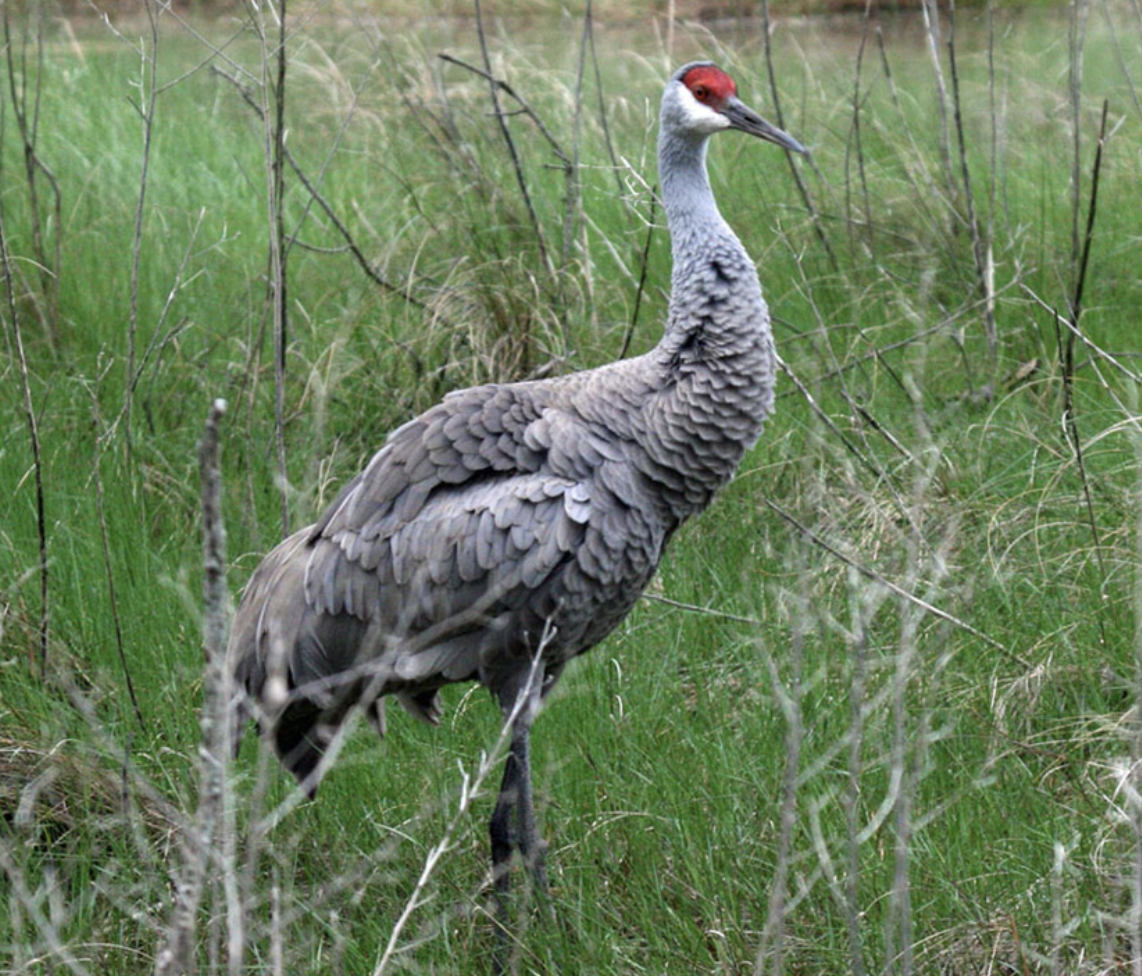
A lone sandhill crane moves through brush, foraging and nesting in Ohio’s wetlands. (Ohio Department of Natural Resources)
Despite this growth, the species remains at risk, having once disappeared from Ohio and still classified as threatened.
Despite the progress, conservationists stress the species remains vulnerable.
Known for their height, long necks, and distinctive bugling calls, sandhill cranes are perhaps most famous for their elaborate courtship dances.
“Perhaps the most unique characteristic of the sandhill crane is its tendency to dance,” according to an Ohio Wildlife Field Guide published by ODNR. “Although an integral part of their courtship, they can be seen dancing any time of the year. The dance of the sandhill crane includes many quick steps around each other, wings half spread, with an occasional leap into the air up to eight feet off the ground. Part of this ceremony includes bowing toward one another.”
However, the behavior isn’t limited to mating season.
“Outside of its occurrence during courtship in the spring, researchers are unclear as to why this behavior continues throughout the year,” the ODNR reports.
Cranes depend heavily on wetlands, where they nest, feed, and raise their young.
After hatching, their parenting strategy is notably hands-on.
“After hatching, the older chick is more aggressive than the younger, and the two must be separated by the parents,” the ODNR wrote. “The parents will split up and walk in separate directions so that one chick will follow one parent and the other chick the other parent.”
Conservation efforts are focused on protecting and restoring these wetland habitats, which are critical to the species’ survival.
“The Ohio Division of Wildlife continues to try and attract sandhill crane populations to the state by restoring their preferred habitats of wetland and grassland,” according to the Cleveland Museum of Natural History, which houses two sandhill cranes in the Ralph Perkins II Wildlife Center & Woods Garden.